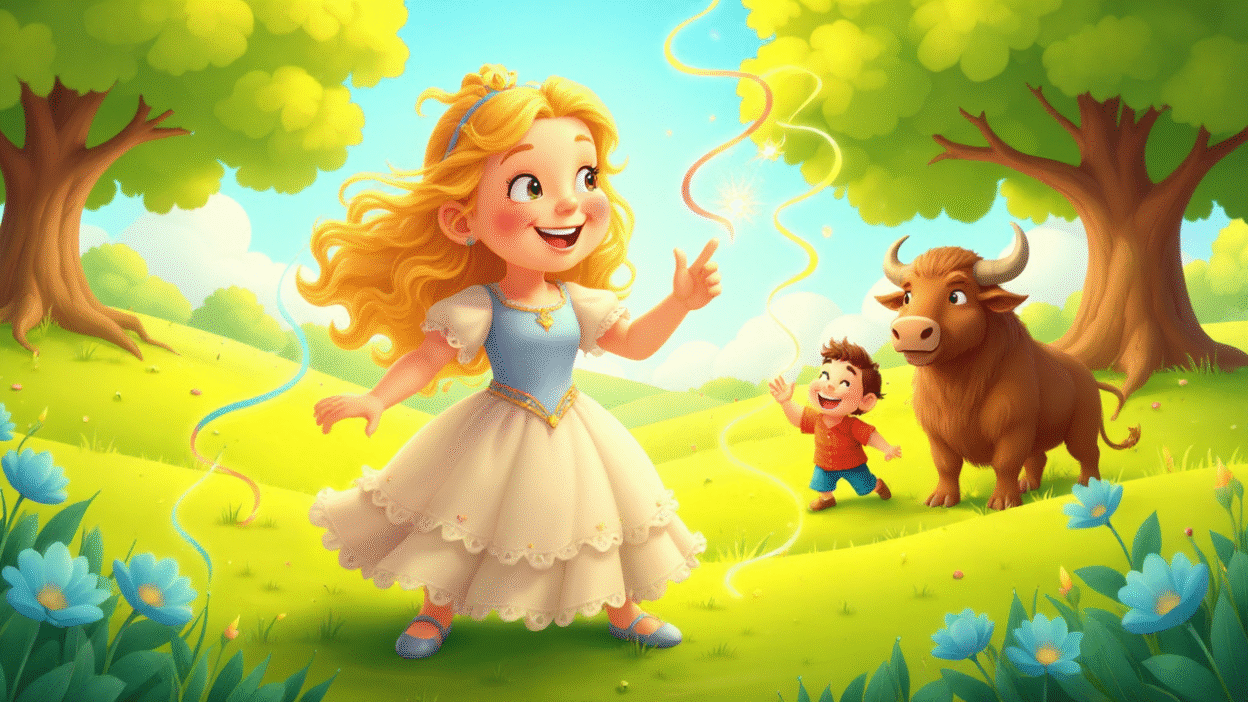
Long, long ago, before ever a blue flax-flower bloomed in Holland, and when Dutch mothers wore wolf-skin clothes, there was a little princess, very much beloved by her father, who was a great king, or war chief. She was very pretty and fond of seeing herself. There were no metal mirrors in those days, nor any looking glass. So she went into the woods and before the pools and the deep, quiet watercourses, made reflection of her own lovely face. Of this pleasure she never seemed weary.
Yet sometimes this little princess was very naughty. Then her temper was not nearly so sweet as her face. She would play in the sand and roll around in the woods among the leaves and bushes until her curls were all tangled up. When her nurse combed out her hair with a stone comb—for no other kinds were then known—she would fret and scold and often stamp her foot.
When very angry, she called her nurse or governess an “aurochs,”—a big beast like a buffalo. At this, the maid put up her hands to her face. “Me—an aurochs! Horrible!” Then she would feel her forehead to see if horns were growing there.
As the years went on, the nurse—now called “governess”—grew tired of the naughty behavior of the princess. Sometimes she complained to the mother, even telling her how the girl called her an aurochs. This only made the princess behave worse. She rolled among the leaves even more and tangled her ringlets so badly that the governess could hardly comb them smooth again.
Punishments seemed useless. Boxing her ears, pinching her arm, spanking her, or taking away her dinner did no good at all.
At last, the governess and mother went to the king. When they complained of the princess, the king was troubled. He could fight strong men with his club and spear, and even giants with his sword and battle-axe, but he did not know how to correct his beloved daughter. She was his only child and all hopes for the future rested on her.
Still, he took comfort in one thing: like her father, she was always kind to animals. Her favorite pet was a little aurochs calf whose mother had been killed by hunters. The princess fed it from her hand and kept it warm all winter.
One day, the king walked gloomily in the woods, wondering how to help his daughter become sweet-tempered. She was growing into a tall, fine-looking young woman, but her temper worried him.
When he himself had been a boy, he had been kind to all creatures, even the trees. He never allowed axe men to cut down an oak until they asked pardon of the fairy believed to live inside it.
There was one great oak near his father’s mansion. People said that babies were found in its leafy branches and brought to their mothers. The boy prince took great care of this tree. A wise man taught him how to prune dead limbs, keep away worms, and stop people from breaking off branches, even for Yule-tide.
Once, hunters chased a young aurochs mother and her two calves into the king’s park. The boy prince ran out and drove the men away. He cared for the creatures until they were strong again. Then he sent a skilled hunter to imitate the aurochs mother’s call and led the father to the edge of the woods. When the family reunited, he set them free and watched them joyfully.
Years later, now a grown king, he had forgotten the incident. One day while walking in the forest, a gentle breeze rose. The leaves of the old oak rustled, then whispered, and finally a clear voice spoke.
“I have seen a thousand years pass since I was an acorn planted here. In a few moments, I shall die and fall. Cut my body into staves and make a wooden petticoat, like a barrel, for your daughter. When her temper is bad, let her wear it until she promises to be good.”
The king was sad to lose the great oak under which he and his fathers had played. Seeing his sorrow, the oak whispered again.
“Do not grieve. Something better will follow. When I am gone, a blue flower will grow here. Where the forest stood, fields will spread. If your daughter is good, young women shall spin something far prettier than wooden petticoats. Watch for the blue flower. And so I am not forgotten, take from now on the family name Ten Eyck—‘at the oak.’”
At that moment, a huge, gray-maned aurochs rushed into the wood. Thinking it would charge, the king drew his sword, but the beast stopped and bellowed. Then its voice changed.
“I die with the oak, for we are brothers under a thousand-year enchantment, which ends now. We never forgot your kindness when you were a prince. When our spirits return to the moon, saw off my right horn and make a comb for your daughter. It will smooth her curls better than stone.”
Suddenly a tempest rose. The king hid behind rocks. When the wind stopped, he saw the oak fallen and the aurochs dead beside it.
His woodmen arrived, fearing for the king’s safety. He ordered them to take the aurochs horn and cut the oak into staves. The next day they made a wooden petticoat and a horn comb. Women from all over the kingdom came to see such wonders.
After this, the king called himself the Lord of the Land of Ten Eyck, and this became the family name of all his descendants.
Whenever the princess showed bad temper, she had to wear the wooden petticoat while children laughed at her. But something curious happened. Each time her hair was combed with the horn comb, she grew gentler. Soon she begged to own the comb herself. Before long, she combed her own curls and became so sweet-tempered that she no longer needed the wooden petticoat.
One summer day, as she walked where the oak once stood, she saw a beautiful blue flower. She plucked it and placed it in her hair. Her aunt, who had traveled south, said it was flax.
That spring, millions of tiny green blades grew where the forest had been. Women learned to soak the flax, separate the silk-like strands, and spin them. They wove the flax into cloth, bleached it in the sun, and made linen—and later lace.
“Let us name the place Groen-e’-veld—Green Field,” the happy people said. And so it was.
When the princess saw how pretty the snow-white linen was, she invented a new fashion. The garment above the waist she called the “boven rok,” and the one beneath, the “beneden rok.”
As more flax was woven, she had more petticoats made. She loved them so much she wore twenty at a time, looking very much like a barrel. All the women copied her style. Soon every bride was expected to have twenty petticoats.
A new custom grew: a betrothed young man—or his female relatives—gave petticoats as gifts to his sweetheart.
Thus the fashion spread along the coast. Women proudly swung their layered skirts as they went to market, sold fish, or knitted by their homes. In many places, nothing pleased a girl more than receiving a new petticoat.
Later, men built a dam to secure water for soaking flax in winter. The linen industry made the people rich. A city rose, called Rotterdam—“the dam where they rotted the flax.”
Because the dark forest had become bright meadows with a silvery stream, the city chose green and white for its arms and seal: two green stripes for the verdure and one white for the water. These colors still appear on the flags and steamship funnels of the great city to this day.
If You Enjoyed This Fairy Tale…
Would you like to read The Tale of the Snow Queen and the Fairy Girl and The Land of Stories
Daha fazlası için Fairy Tales sayfamızı ziyaret edin!